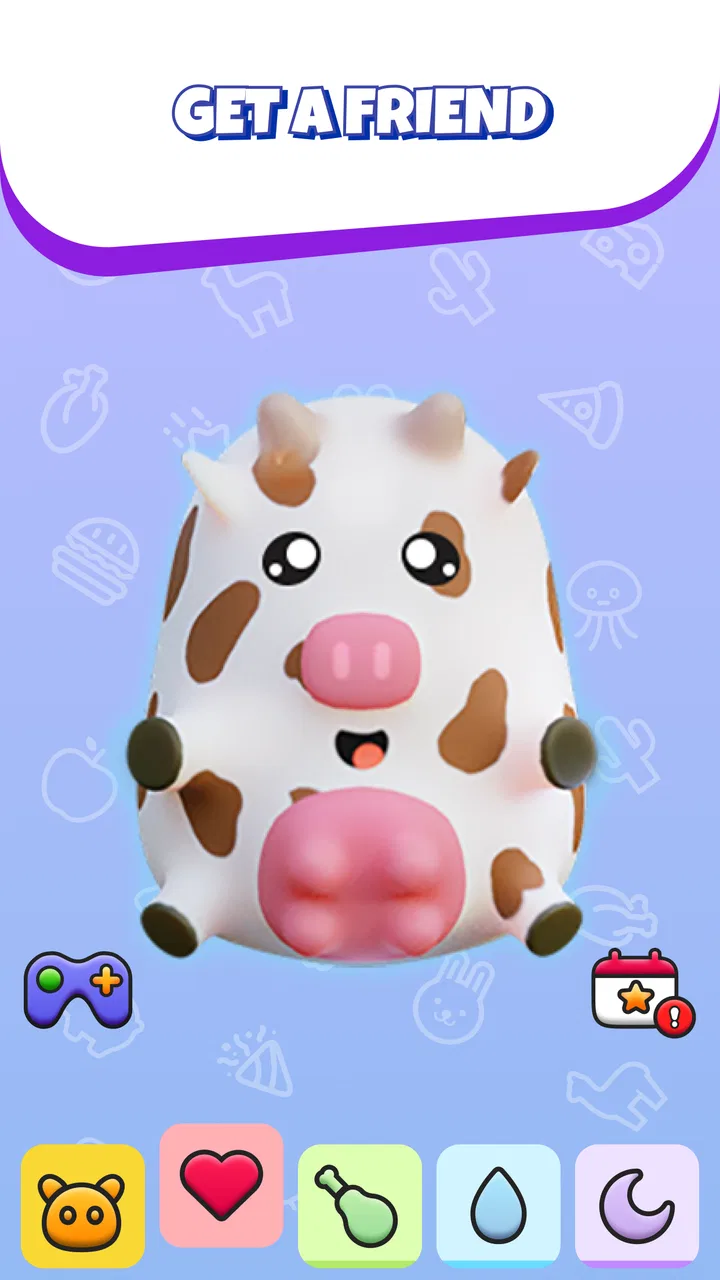
Tamagoo: Buddy Slime Pet Games
- 3.9
- Rating
- 5.00M
- Installs
- Free
- Price

 Analysis by App-foxy
I approached Tamagoo: Buddy Slime Pet Games expecting a tiny distraction, and that is exactly where it makes the most sense. This is a free simulation game from Vexuse built around caring for and squeezing a soft-looking three-dimensional slime companion. It is less about winning than about creating a small, calming routine: open the game, interact with the pet, enjoy the tactile animations, and leave when you feel ready.
That simple idea is both its strongest quality and its main limitation. I found it easy to understand within moments, with no complicated tutorial or demanding objective structure getting in the way. At the same time, anyone looking for a deep virtual-pet system, a substantial story, or a traditional game loop may find the experience too narrow. My overall impression is that Tamagoo works best as a short, repeatable relaxation toy rather than as a full-scale simulation.
How the current version feels to use
The game’s identity comes from direct interaction. The slime is designed to be squeezed and squished, so the pleasure comes from touching the companion and watching it respond rather than from managing a large collection of menus or completing long missions. That makes it particularly approachable when I want something undemanding after work, during a short break, or while listening to music.
You May Also Like

 Blood Strike: 2.5 Anniversary
Blood Strike’s Loadouts Turn Every Drop Into a Tactical Gamble
A close look at Blood Strike’s custom loadouts: how fast access to signature weapons reshapes its battle royale rhythm, rewards preparation, and narrows the gap between fights.

 Pandora - Music & Podcasts
Pandora’s Music Is Easy to Start, but Harder to Recover
Pandora’s strength is its low-effort path from a seed to a station. Its weak spot is how much confidence it asks you to place in connection, setup, and quiet recovery.

 8 Ball Pool
 Is Built on Rivalries, Rematches, and Routine
A close look at the rivalries, rematches, shared routines, and unanswered safety questions that turn a quick pool match into a persistent mobile community.

 Samsung Music
’s Quiet Strength Is Playing What You Already Own
Its reach comes less from spectacle than from dependable access to a personal library. That simplicity is both the app’s strongest retention engine and its ceiling.

 AccuWeather: Weather Radar
AccuWeather Review: A Quick, Clear Forecast for Everyday Decisions
For everyday plans, the best forecast is the one you can understand quickly. AccuWeather makes rain timing, radar, and local conditions easy to act on, with a few trade-offs.

 Hill Climb Racing
Why Hill Climb Racing Still Turns Crashes Into One More Run
A tiny car, a bumpy hill and one more upgrade: Hill Climb Racing keeps resurfacing because its simple chaos makes every near-miss feel personal.
More From Our News Desk
View All News


The presentation also explains why the game can appeal to people who do not normally play simulation titles. There is no need to learn a complicated economy, memorize controls, or understand a large world. The central action is immediately readable: interact with the slime and see what happens. For younger players and casual users, that clarity is a real advantage, especially since the content rating is Everyone.
I would describe the mood as playful and soothing rather than competitive. The store positioning focuses on calming effects, and in practice the game is most convincing when treated as a small antistress activity. It is not a replacement for a dedicated mindfulness tool, but it can provide a gentle sensory pause. I sometimes found that the value was in the first few minutes, before the novelty of the interaction began to fade.
Because it is free to start, the initial decision is easy. You can try the central experience without committing money, then decide whether the available activities justify spending anything. The in-app purchase range runs from $9.99 to $99.99 per item, so I would advise treating purchases carefully and checking what each one actually adds before confirming anything. A free entry point is welcome, but it does not automatically mean the complete experience will feel equally generous.
A useful game for short, predictable breaks
A realistic use case is a student taking a few minutes between study sessions. Instead of opening a competitive game and getting pulled into a longer match, they can check on the slime, interact with it, and close the app without needing to remember a complicated objective. The same applies to someone waiting for an appointment or trying to step away from a stressful conversation.
My practical tip is to give the game a defined place in your routine. A brief visit works better than expecting it to occupy an entire evening. If I approached it as a complete entertainment package, the limited scope became more obvious. If I treated it as a small interactive toy, the focused design felt more appropriate.
Another useful approach is to pay attention to how you respond to tactile repetition. Some players enjoy repeating a simple gesture because it is predictable and relaxing. Others need constant goals, new levels, or changing challenges to stay interested. Tamagoo strongly favors the first group. That distinction matters more here than the usual question of whether someone likes simulation games in general.
What the version history means for players
The current version is 3.0.7, which places the game well beyond its original release on October 25, 2022. That progression suggests an app that has continued to receive attention rather than remaining frozen at its launch state. However, a version number by itself should not be treated as proof that every aspect has been transformed. The important question is how the present build feels in daily use, and its core appeal remains the direct slime-pet interaction.
For a returning player, the most sensible expectation is refinement around an established concept rather than a completely different game. I would not reinstall expecting a large adventure or a new genre hidden behind the update number. The evolution is better understood as the product becoming a more established version of its original virtual-pet idea.
That distinction is useful because it prevents disappointment. Players who already enjoyed the gentle, tactile premise are the ones most likely to appreciate continued development. Someone who disliked the basic loop will probably not be persuaded simply by seeing a newer version number. In my experience, the foundation determines whether the game works for you.
The audience size gives the project some context: it has passed five million installs and carries an average rating of 3.9 from around thirteen thousand ratings. Those figures suggest broad curiosity and a generally mixed-to-positive reception, not universal approval. I read that as a reason to try it personally rather than relying on popularity alone. A calming toy can be highly effective for one person and boring for another.
What existing users gain, and where friction remains
For an existing user, the biggest benefit of staying with the game is continuity. A virtual pet is more appealing when it becomes familiar, and a returning player can use the slime as a dependable little break instead of learning a new system each time. The uncomplicated format also lowers the cost of returning after a long absence.
There is a trade-off, though. Familiarity can turn into repetition. If your enjoyment depends on discovering new mechanics, the same accessible design that makes the game relaxing may eventually feel shallow. I would judge the game by whether the interaction itself remains pleasant, not by expecting it to provide the constant progression of a collection game or a management simulator.
Monetization is another point existing users should keep in mind. Since individual in-app purchases can reach $99.99, the free starting price should be viewed as an invitation to sample the game, not as a guarantee that every desirable option is included at no cost. I prefer to decide in advance whether I am willing to spend and to avoid buying simply because a virtual companion creates an emotional attachment.
This is especially important for families. The Everyone rating makes the game broadly accessible, but adults should still explain that optional purchases may appear. The age rating describes content suitability; it does not remove the need for sensible purchase controls. For a child, the squeezing and pet-care theme may be appealing, yet the payment side deserves the same attention as it would in any free-to-play title.
Device compatibility is reasonably welcoming for older Android hardware because the minimum operating system is Android 7.0. That helps people who do not use the newest phone, although the actual comfort of play will still depend on the device and its performance. I would install it with realistic expectations: compatibility makes trying it easier, but it does not guarantee identical smoothness on every handset.
How it compares with familiar alternatives
Compared with a traditional virtual-pet game, Tamagoo feels more focused on touch and mood than on elaborate caretaking. A conventional pet simulator may ask you to manage hunger, cleanliness, schedules, rooms, or several kinds of progression. Here, the slime’s physical interaction is the main attraction, so the experience is less like raising a detailed digital animal and more like handling an animated stress toy.
Compared with a puzzle game, it offers far less pressure and almost no reason to optimize your performance. That is a strength when I want to unwind, but a weakness when I want satisfying problem solving. Puzzle alternatives are better for players who need clear goals and measurable improvement. Tamagoo is better for someone who wants to interact without being judged by a score.
It also differs from idle games. Idle titles usually reward waiting, upgrading, and checking numerical progress. This game’s appeal is more immediate and physical: the point is what you do during the visit, not simply what accumulates while you are away. If you enjoy watching values rise, another simulation may hold your attention longer. If you find numbers and upgrade screens tiring, the slime concept is likely more comfortable.
Even a dedicated relaxation app may be a better choice for someone seeking structured breathing exercises, sleep guidance, or a clear wellness program. Tamagoo can create a calming pause, but I would not mistake its playful interaction for professional mental-health support. Its benefit is informal and personal, which is precisely why it feels easy to use but also limited in scope.
Who should try it, and who should skip it
I would recommend giving it a chance if you like cute digital companions, tactile animations, and games that can be opened for a few minutes without preparation. It is also a good match for people who want a low-pressure simulation experience and do not need a campaign, leaderboard, or complicated customization system to feel entertained.
Parents looking for an accessible game for a child may appreciate the simple premise and Everyone rating, but I would still supervise purchase settings. The game is also suitable for adults who enjoy playful stress relief; there is no reason to assume that a slime pet is only for children. Its appeal is more about the sensation and routine than about age.
I would skip it if your ideal game involves deep progression, strategic decisions, competitive goals, or a large amount of content. I would also be cautious if you dislike repetitive touch interactions or feel frustrated by free games that present optional purchases. In those cases, a paid, self-contained simulation or a more feature-rich virtual-pet title may offer better value, even if its first download requires payment.
One non-obvious trade-off is that the game’s simplicity can make it easier to use responsibly, but it can also make purchases feel more noticeable. When the basic interaction is so focused, any paid additions carry more weight because there are fewer other systems competing for attention. I recommend spending only after several free sessions have shown that the central activity genuinely fits your routine.
Small habits that make the experience better
I found three habits particularly useful. First, use it as a transition rather than an endless session: open it when moving from work to rest, interact for a short while, and then put the phone down. This preserves the calming quality and avoids asking a very small game to provide hours of entertainment.
Second, test it in different moods. A game that feels charming when you are tired may feel too repetitive when you are alert and looking for stimulation. Trying it after a stressful moment, during a quiet wait, and at the end of a busy day gives you a more honest picture of its value than one long first session.
Third, separate emotional attachment from spending decisions. The virtual-pet format is designed to feel personal, so it is easy to think that buying something is a way of caring for the companion. I find it healthier to decide on a budget beforehand and judge every purchase by practical enjoyment rather than by guilt or urgency.
These habits also clarify what future development would matter most. New interactions that preserve the gentle tone could make returning worthwhile, while additions that introduce pressure or clutter could weaken the original appeal. For now, the best version of the game is the one used deliberately and lightly.
What I would watch as the game continues
The most important thing to watch is whether future updates deepen the slime relationship without turning the experience into a busier management product. More variety could help with long-term interest, but too many systems might undermine the immediate, calming interaction that gives the game its identity. I would favor thoughtful additions over a large number of distractions.
I would also pay attention to how optional purchases fit into the free experience. A fair balance would let curious players understand the game and enjoy its central loop before asking them to spend. Since the purchase range is wide, clarity matters just as much as the amount of content. Players should be able to tell whether they are buying meaningful new interaction or simply decorating a short-lived novelty.
The developer, Vexuse, has already carried the project from its 2022 launch to the current 3.0.7 build, so continued maintenance is a reasonable expectation to monitor. I would look for updates that improve comfort, preserve accessibility for compatible devices, and give returning players a reason to revisit without forcing them into a more demanding style of play.
My final view is favorable but carefully limited. Tamagoo: Buddy Slime Pet Games is a pleasant interactive companion, not a deep simulation. I like it most when I need a small, harmless pause and want something more playful than a static relaxation exercise. The free entry point, Everyone rating, and straightforward tactile premise make it easy to test, while the repetitive loop and potentially expensive individual purchases mean it is not an automatic recommendation for everyone.
If you already enjoy virtual pets or calming sensory games, I think it is worth trying with modest expectations. Give the free experience enough time to see whether the slime interaction actually relaxes you, keep purchases deliberate, and compare it honestly with a richer pet simulator or a structured wellness app. For the right player, this focused simplicity is the point; for everyone else, it may be a charming idea that runs out of room too quickly.
FAQs for Tamagoo: Buddy Slime Pet Games
01What is Tamagoo: Buddy Slime Pet Games?
Tamagoo: Buddy Slime Pet Games is a virtual pet app centered on a cute, customizable slime companion. After choosing or creating your buddy, you can interact with it, keep it happy, and take part in simple mini-games and daily activities. The experience is designed for casual play, with colorful visuals and short sessions that are easy to enjoy whenever you have a few spare minutes.
02How do you take care of your slime pet in Tamagoo?
Caring for your slime buddy generally involves checking its needs regularly and responding through available interaction options. Depending on the activity, you may feed it, play with it, clean or look after it, and use different items to improve its mood. Consistent attention helps make the pet feel more rewarding to manage, although the app is intentionally simple and suitable for players who prefer relaxed virtual-pet gameplay.
03Does Tamagoo: Buddy Slime Pet Games work offline?
Some of Tamagoo’s basic pet interactions and mini-games may remain available without a constant internet connection, but offline access can depend on the specific version, device, and feature being used. Online connectivity may still be required for advertisements, purchases, updates, cloud-related functions, or additional content. It is best to launch the app online at least once and review its behavior before relying on it during travel.
04Is Tamagoo suitable for children, and does it contain in-app purchases?
Tamagoo uses friendly cartoon-style graphics and straightforward controls, which can make it appealing to younger players. However, parents should check the store age rating, privacy details, and the app’s current permissions before installation. Like many free mobile games, it may include advertising or optional in-app purchases for items, upgrades, or other content, so parental controls are recommended on shared devices.
05What devices are compatible with Tamagoo: Buddy Slime Pet Games?
Compatibility depends on the operating system, device model, available storage, and the minimum software version specified on the official Google Play or App Store listing. Before downloading, check the current requirements for your Android or iOS device and make sure enough free space is available. Keeping the operating system and the game updated can also help prevent crashes, loading problems, or missing features.
Pros
- Cute slime pets are easy for children to understand and enjoy.
- Short activities work well for quick play sessions.
- Bright visuals and playful animations make the app appealing.
- Pet-care tasks encourage routine and gentle responsibility.
- Simple controls are suitable for younger players.
Cons
- Some activities may feel repetitive after extended play.
- Progress can be slower without optional purchases.
- Frequent prompts may encourage children to keep playing.
- The app may require substantial storage on older devices.
- Parents should review privacy and purchase settings first.

Tamagoo: Buddy Slime Pet Games
Gallery